Before anything, we co-regulate our nervous systems

I just returned from a little holiday with my sons. On the last night, across the most breath-catching view of purple hills broken only by swallows diving in darts that matched my second thoughts, I asked my boys, “So does anyone you know talk about the metacrisis?” With soft, patient smiles they get ready for what’s coming and wonder whyyyyyyy would I break the perfection of our gazpacho with THAT question? (They also know me well: jolts of particularly intense joy often co-arise with some sadness for me, but that’s for another post).
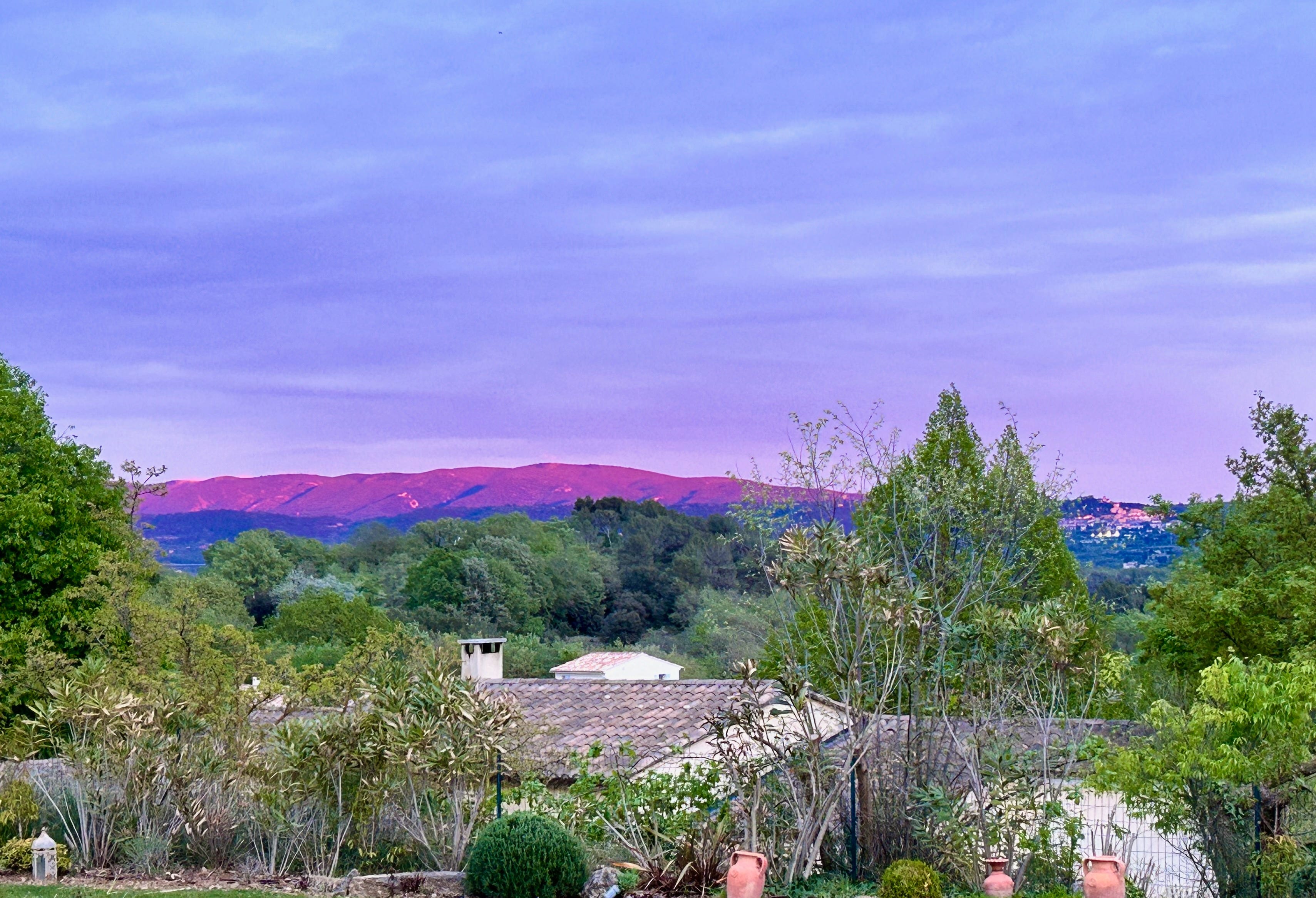
One of my boys answers (with the other nodding along): “No one talks about it. No one really cares. No one really thinks we can do anything about it. If the wars or the next political shit-storm or AI stealing jobs or the fact that we’re literally on a ball of fire comes up, we just distract ourselves, move on.” (Note: It was 35 degrees in France, in May, as we were speaking). In short, no, the metacrisis doesn’t really come up. Maybe this is good news? Maybe they’re more chill than I worried?
“Are you all happy in the meantime, in this distraction?” I asked. “Nope. Dread is more like it. But it’s cool… like, we don’t think about it much. It’s just kinda the air we breathe. What are we supposed to do about all of it anyway?” He made a vague arm-flapping gesture of “all”.
I noticed my heart rate jack up in those few minutes of conversation, anticipating how I’d ease into some version of the empathic, empowering (!!) talk I had been rehearsing for at least 5 years. My shoulders cramped up against my ears, my breath caught somewhere near my collarbone, and my jaw did that something my dentist keeps freaking out about. That is not a great launch position for a considered response. It is also, for many of us reading and writing in this space, the baseline anxiety against which we push. I had missed the rest of the sunset, somehow.
Here’s the problem: a nervous system running chronic threat-detection is not a platform from which we can do much of anything well. With our cortisol elevated and our fight/flight/freeze readiness switched to “vigilance mode,” clear thought and curiosity is nearly impossible to access. Chronic stress measurably impairs the prefrontal function required for complex reasoning and flexible interaction. And we REALLY need some complex reasoning right about now. We also can’t skilfully connect emotionally, because a threat-activated nervous system narrows what we see in front of us: everything looks dark and looming and scary as hell. We certainly can’t parent well in this state.
The dread, as Nate Hagens is naming it, makes biological sense. The crisis, or the collapse, is real enough to warrant this sense of dread.
“From 2021 to 2024, many people would be asking me, what evidence do you have that modernity is in decline? From January 2025, nobody asks me again this question specifically, because it’s so in your face now.” — Vanessa Machado de Oliveira
Of course I’m not going to suggest to put it down entirely. But dread as a permanent operating state, as the atmosphere inside which we try to continue to raise our adult kids and sustain our relationships and take whatever actions we can still take, is corrosive in specific and measurable ways. Chronic nervous system activation depletes the very resources we need for what’s coming.
(Nate Hagens’ recent podcast on The Dread is so good. Have a listen when you can.)
The response is bigger than any one of us
Cordula Frei has a fascinating argument linking the complex relations with our nervous systems and change at global scales: what we call “systems” (capitalism, education, government) are not external machines acting on passive individuals. Instead, they are stabilized patterns of perception and embodied response that human nervous systems continuously generate and reinforce. When progressive frameworks propose redesigning capitalism or building ecological civilizations, they’re rearranging the conceptual furniture while leaving untouched the perceptual-organic substrate that produces those systems in the first place. A bad system persists not only because of formal rules or incentives, but because enough participants continuously re-enact its logic at the level of attention, desire, and bodily reactivity, most of it operating below the threshold of rational policy debate. The villain in her account is chronic nervous system dysregulation: the state of scarcity anticipation, competitive vigilance, and identity defense that modern life normalizes. From that dysregulated state, people can’t perceive relational interdependence, can’t tolerate uncertainty without grasping for control, and can’t act from anything other than survival logic. The body is shut down and its crisis mode perpetuates the continued manic extraction because it’s all that it knows.
So yes, we need to regulate our own nervous systems. But I don’t think this is largely a personal regulation problem and I think continuing to insist that each person do their own meditation, yoga, deep breathing exercises, and go for yet another run to cool off perpetuates some of the very stress responses we’re trying to attenuate. None of these individual regulation efforts are wrong. But I want to talk about moving beyond the individual and considering the critical role of co-regulation… regulation with others.
The “oxygen mask” metaphor — put on your own before helping anyone else with their’s — is not wrong either. I am told, in terms of survival chances when a plane is going down and depressurized, this is the only right answer. But the flight attendants need to remind you that this is the “correct” process because it’s incredibly counter-intuitive, especially for a parent.
The model of the “oxygen mask” that everyone likes to evoke seems incorrect to me. It assumes that the individual person is the basic unit of biological sense we should be most concerned with, that regulation is something a sealed unit does privately, gets sorted, and then brings to the dyad or the group. Our actual biology tells a different story. Beckes and Coan (2011, Social and Personality Psychology Compass) synthesized neuroimaging and behavioral data to argue that the mammalian brain treats social isolation as an ecological emergency, precisely because operating alone is metabolically expensive. Social proximity is the biological baseline: when safe others are nearby, individual nervous systems can outsource risk and directly downregulate the vigilance networks and metabolic costs of going at it alone. In a massive review published in 2014, West and Mendes documented the underlying mechanism, showing that real-time autonomic markers like heart rate and skin conductance synchronize within pairs, the nervous system of one person pulling another’s toward stable, calm regulation or dysregulation in real time. Mammalian nervous systems, in their account, are open-loop structures that rely on interactive feedback to achieve homeostatic (balanced) regulation. Finally, Sapolsky’s (2005) synthesis of decades of primatological data in Science grounds all of this in evolutionary time: grooming networks and reciprocal social relationships act as direct physical buffers against glucocorticoid stress hormones, producing measurable HPA-axis suppression mediated by social contact rather than individual effort. We are wired, at the level of our stress hormones, to regulate through and with each other.
This co-regulation begins before language. Developmental research tracing mother-infant interactions found that as early as two months, infants and caregivers are mutually regulating each other’s emotional states in intricate, rhythmic patterns: vocal, facial, gestural, simultaneous. The infant doesn’t self-regulate and then communicate. The communication IS the regulation. We don’t start as isolated systems that later learn to connect. We start embedded, and individuation grows inside that embeddedness. I’m arguing that the basic architecture doesn’t disappear when we turn twenty-five.
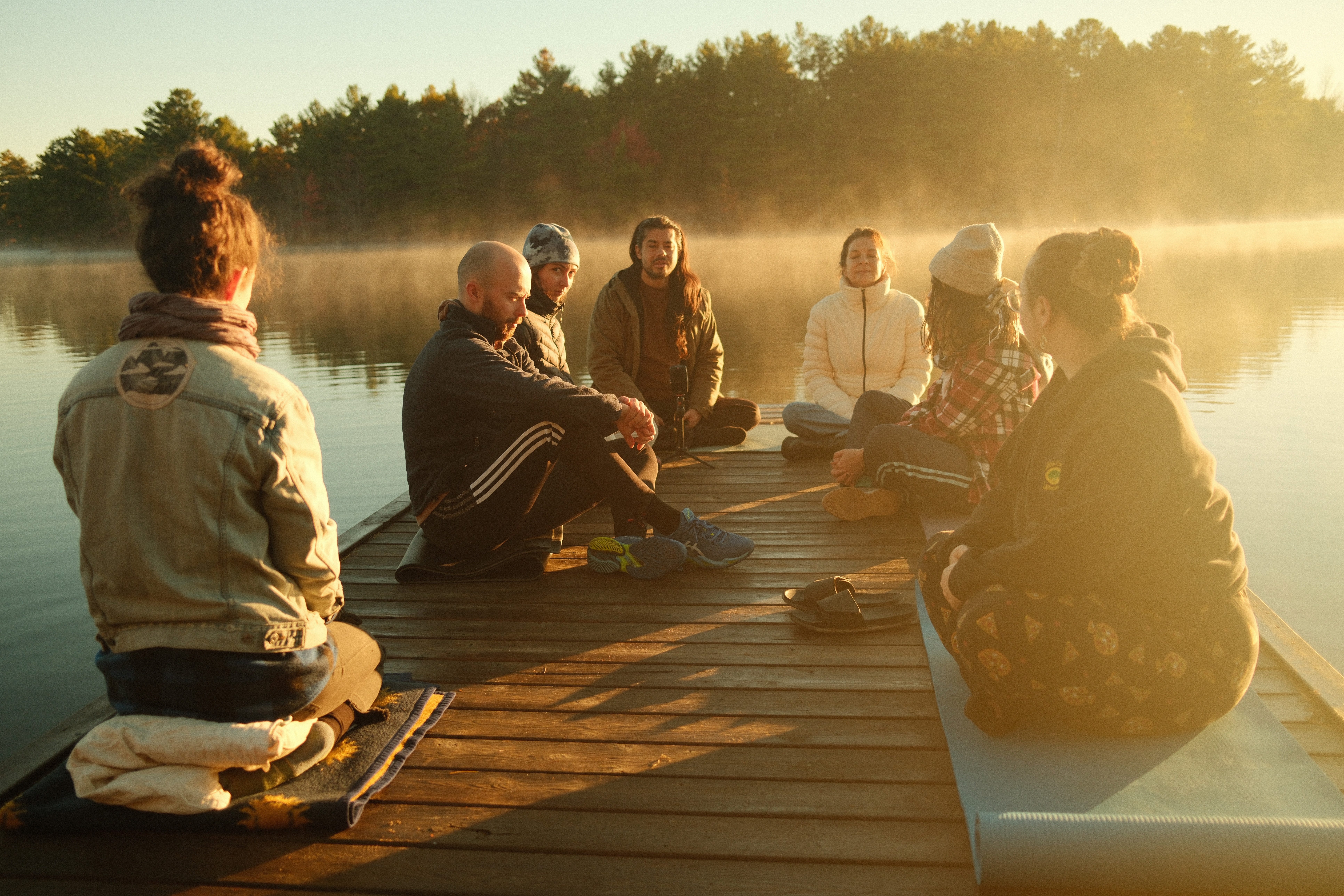
Dacher Keltner’s research on feelings of awe extends the idea of co-regulated nervous sytems across the lifespan: he shows that when we witness suffering, some people mirror that in their own neurobiology and are more likely to cooperate, more likely to act on behalf of others, and more likely to feel morally stirred by what they see. The nervous system has its own ethics encoded in it. The question is whether we give it conditions to function properly.
Treating regulation as a private task completed before collective engagement gets the sequence wrong. Collective regulation is the substrate from which sustained action becomes possible. Action built on top of chronic individual dysregulation tends to be brittle, reactive, and hard to sustain across time.
Liminal Learning: Applying theory to collective practice
These insights about co-regulation are part of the foundational principles upon which we’ve built Liminal Learning, the program I co-founded for young adults in the 18-25 age range. We begin with a Quest: a week in wilderness, without the digital scaffolding of ordinary life. The first thing that happens is not insight. The first thing that happens is the nervous system slowing down enough to notice what’s actually there. Young people arrive at the Quest dysregulated in ways they’ve long since normalized: the permanent low-grade alarm, the ambient scrolling, the sense that attention has been pre-divided before they’ve even chosen what to focus on.
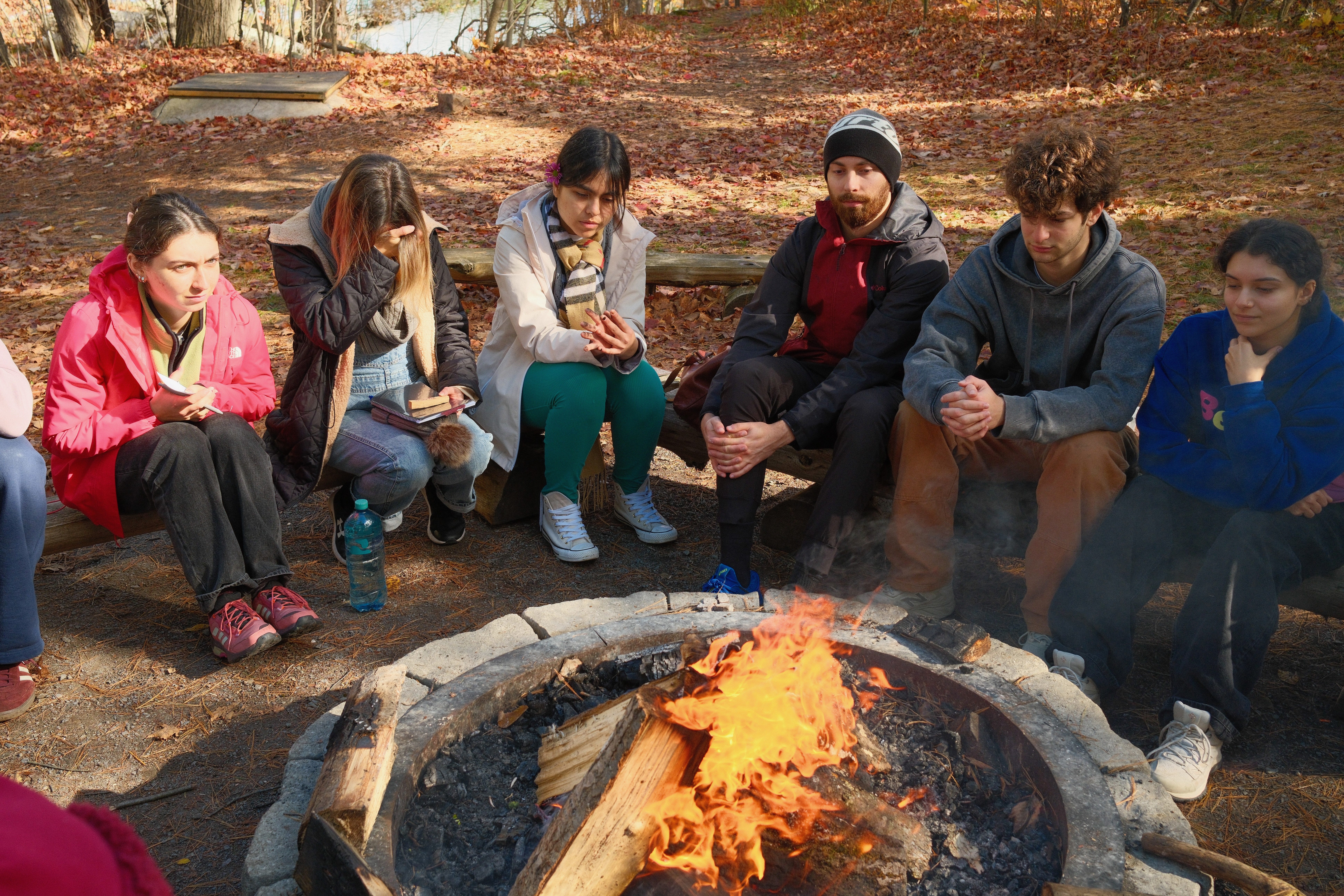
By day three, something shifts. They start co-regulating: with the land, with peers, with elders who aren’t performing certainty and instead modeling our own regulation efforts. That co-regulation is not the warm-up act before the real developmental work begins. It IS the developmental work. Everything that unfolds over the rest of the year, including the meaning-making, the collaborative projects, the slow translation of what genuinely stirs them into something offered outward to the world, happens inside the container that co-regulation builds.
The work, then, is to find and build the relational conditions inside which we can be present to what’s actually happening, and present to each other at the same time. That might happen in a kitchen. It might happen in the woods. It might happen in the twenty minutes between picking up a kid from school and the dinner rush, if we’ve made the biologically and evolutionarily-rooted promise to be there in the muck of collapse and repair.
If you know a young person launching into adulthood who is interested in finding community and collective purpose, we’d love to offer them a place at Liminal Learning. It’s a non-profit program, but it’s also a community and, increasingly, the community is becoming part of a bigger movement preparing for a world in flux with social action and care. We’re also super excited to be expanding from Canada into the UK this year. We have a handful of scholarship places available, supported by our nonprofit mission, so please share with anyone you think would be interested:
https://liminal-learning.com/upcoming-quests
In case anyone didn't know, I'm totally in with your approach Isabela … to me, the insistence on "me first" development feels more like a vestige of the very individualism we are trying to transcend and include in a greater context. But, naturally, this is easily overlooked, as the individualistic culture is all around us, so feels natural. Also, those in transition from "socialised" to "self-authored" are likely to defend individualism (perhaps under the banner of "individuation" or "self-actualisation") against what is seen as a retrogressive form of collectivism.
How can we support people into this recognition that the relational field we are talking about is not the oppressive, normative traditionalism that is understandably rejected?