GenZ is Different: Part 2

A few weeks ago, my son and his friend (the one whose rent doubled) jumped into my backseat for a ride to their friend’s place. Since my boys were toddlers, I’ve always loved driving them and their friends around, the back seat like some kind of Star Trek teleporter into which the kids imagine they’ve vanished to their own sound-proof planet, while I happily eavesdrop. This friend is thoughtful and capable and carrying a weight heavier than most 20 year olds in their peer group. He says he’s “all good” moving back in with his own mother: “Yeah, she’s chill and she cooks way better than any take out I’ve had all year.” My son asked if it was weird going back into his old life with rules and someone always watching over him. “Nah, she lets me do my thing and I actually don’t mind helping her now that I don’t have to.”

That last part stuck with me. This young man is making sense of a liminal time, going back to his childhood home that’s familiar but also very changed. It isn’t dependence in the way so much of media portray young people, as if they’re slinking back home because they can’t hack “the real world.” And it isn’t independence either; there is a return to safer conditions of care and stability. But I think the dichotomy between independence and dependence is false here, at least at this developmental stage. Something about the relation between the two morphs continuously during this period.
In the first part of this series, I argued that the rise in distress among young adults of GenZ reflects very different developmental conditions than previous generations have had to cope with. It isn’t that they’re just a lazy or more vulnerable cohort of youth. Instead, conditions such as housing instability, precarious work, institutional distrust, and educational irrelevance make life genuinely harder for them. In this post, I’d like to deepen that observation and suggest that these changes in systemic conditions do a great deal more damage by interfering with how young people make sense of their experience, or more specifically, how and what they learn from what they do.
One of the pioneers in the mindset research, Carol Dweck (2017), Psychological Review, has described development in terms of linkages among beliefs, emotions, and action tendencies that get built through repeated experience. What is built through experience is not just abstract attitudes about the world around them. They are actively building working models to make sense of their place in the world: When I try hard, what happens? When I fail, what follows? When I depend on someone, do I get met, ignored, or controlled? Do my choices matter and in what circumstances can they be changed or are they irreversible?
These models shape how we understand subsequent relational processes; they make us see the world in a certain way and provide a set of short cuts for how we should act in all sorts of future social contexts. Importantly, actions need to meet consequences that we can register, interpret, and revise accordingly. Not perfectly, not cleanly, but reliably enough that something coherent carries forward. And what carries forward needs to be useful for interpreting the world onwards. And other people, people who care deeply about us, need to reliably collaborate with us in making meaning of so much feedback from a world that often doesn’t slow down for us to take notes. So it’s also important to have stable friends and family who help us build and stress test our working models.
What seems to be shifting for many young adults is not only the difficulty of particular conventional “success” metrics—finding stable work, securing housing—but how many of the environments that they are moving through now interrupt the processes that build stable working models. This is what I’m sensing from my own adult sons and the other young adults I work and talk with: Their effort doesn’t reliably connect to outcomes. Feedback is inconsistent or delayed at school, in the workplace, and from family members who no longer know the rules of the “success game.” Their participation often feels randomly required or goes unnoticed in the family or in school contexts. Recognition is decoupled from their contribution. People around them don’t have stable expectations of them and it’s unclear if anyone is paying attention to what they’re stepping up to or not. Under those conditions, a young person’s motivation is not the actual problem. The problem is that the systems they’re embedded in are teaching them something about how effort lands: it basically doesn’t matter how much effort they put in, most of the time, except for sometimes when it might. Effort at what, when, and with whom is probably more important, but where to get practice building the right mindsets with that much uncertainty remains confusing.
There is fairly good evidence that key domains of early adulthood have become less predictable. Not just more negative but more chaotic. Youth labor markets have grown more precarious across OECD countries over the past two decades, with higher rates of temporary employment and underemployment relative to older cohorts. Housing costs have risen faster than wages in many regions, delaying independent living and increasing reliance on family systems. Measures of institutional trust have declined across multiple surveys, including long-running work from Pew Research Center. None of this is evenly distributed (and that unevenness matters, but again, unpredictably) but taken together it points to a developmental landscape in which the connection between effort and outcome is harder to read than ever before.
Under these conditions, hesitation can be an intelligible response. If the system delivers inconsistent feedback, then calibrating effort becomes a more complex problem. Where to invest, how much to risk, when to persist, are no longer straightforward judgments.
So how do these macro-level instabilities intersect with the much smaller environments in which young adults still spend a great deal of time. What’s a parent or caring adult to do, in other words? One of my favourite developmental theorists, Donald Winnicott, writes about the “holding environment” that’s best for young children, but I think it’s a powerful concept across development. He showed how important a relatively stable, warm, and responsive social context is for children to develop healthy, secure, and curious personalities.
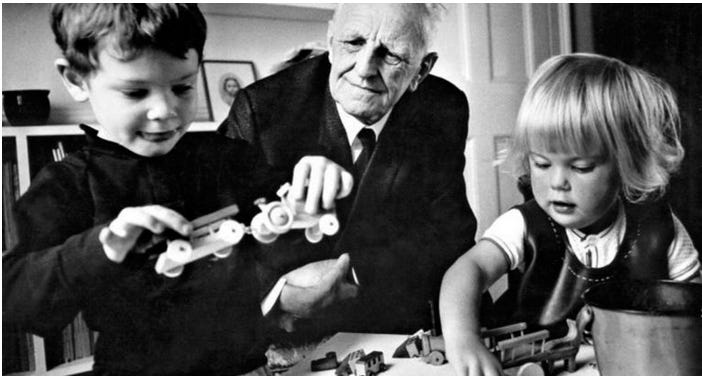
Winnicott’s principles of effective play (and learning) seem just as relevant for emerging adults. And yet so often we create the opposite for them: A young adult starts describing something they are trying to figure out, and the listener—often a parent—recognizes the category of thing that’s being discussed and almost immediately jumps in. Advice follows, or a reframing, or a narrowing of what is being said into something more legible. It is rarely malicious on the part of the parent; often they just want to be efficient. But it can be unintentionally corrosive. By jumping in too early, we interrupt the process by which experience might have been allowed to meet reality more directly and generate its own revision. Interrupting the exploration young people often do in conversations with us also misses important opportunities to feel seen, heard, witnessed in a way that makes them feel like their existence matters.
This is where I want to return to the earlier moment in the car with my son’s friend because what that young man described sounded like a setting in which his helping actions (in the home with his mom) had consequence without being over-scripted. He was needed in ways that registered, but he was not compelled in ways that erased his agency. That combination is not easy to reproduce. It sits awkwardly with many of the cultural models we have inherited, which tend to polarize independence and dependence into mutually exclusive states.
Many young adults I see are moving between forms of partial independence and partial reliance, sometimes by necessity, sometimes by choice. In the midst of these oscillations, “holding environments” that help them iterate on what they care about may not be so complicated to foster. It may be as ordinary as contributing to the functioning of a household in ways that have real consequences if they are not done, or participating in a shared project with peers where others are depending on follow-through. The scale varies but the form is similar. Action meets response and that response is tracked, it matters. Something carries forward.
In terms of data, the resilience research identifies four holding environments that can help young people build useful working models to live by: genuine attention to young people’s actual experience rather than the experience we think they should be having; consistent rather than crisis-driven presence; real expectations of their competence rather than protective management of failure; and the sustained experience (built through behavior, not reassurance) of being treated as a serious person. We can ask what they think, not only how they feel. We can share our genuine uncertainties rather than performing stability that isn’t real. We can engage seriously with their emerging worldview, especially where it diverges from ours. Give them real problems to help solve, because being genuinely useful to someone who respects you is among the more powerful antidotes to purposelessness.
There are limits to what can be done at this level. Families and small relational networks can’t compensate for structural conditions that systematically undermine the stability of developmental inputs. Social epidemiology is quite clear that individual and family-level resources can buffer risk, but they don’t erase it, and the distribution of those resources is itself constrained by larger systems. It would be a mistake to read this argument as suggesting that changes in parenting can solve what are, in part, political and economic problems.
And still, the environments we directly participate in are not neutral. They either support or further disrupt the processes through which young adults build workable models of how the world responds to them. I suspect many of us know when we’ve mustered a holding environment that feels enriching and alive with possibility for our adult kids: their faces lose their tightness, they lean in just a little closer when they’re loading the dishwasher, they share one more dumb cat video before bed.
I think young adults are keenly attuned to the unique contexts that help them build working models to navigate their uncertain worlds with more balance and support. I’d love to hear how others are co-creating these “holding environments.”
I have a 20-year-old son who is feeling pretty lost in the soft turbulence of not knowing what to do with his life. This during a period when he has the support and security of a family home to live in, while waiting for a meaningful work-study experience to unfold in a few more months. I find it hard to know how to hold him (in the Winnicottian way) without taking over too much of his growing space -- the space you describe in which young people might find their way through present complexities without being told what to think or feel or how to decode those complexities (according to my own old-fashioned precepts).
One point on which we seem to be able to reflect together, productively, is the problem of motivation itself. I want to say, c'mon get motivated. He wants to say my motivation will come when...it comes. We both know that neither of these approaches has much traction. What we agree on is that he feels the lack of motivation as a burden. And I know it's not really "his fault," nor is it an easy task for either of us, because, as you say, “the connection between effort and outcome is harder to read than ever before.” (He's tried enrolling in two different post-secondary education streams in the last two years, and volunteering in a receptionist role that fell between various cracks, and none of those attempts came close to rewarding or even recognizing his efforts.)
So...what to do? I try to reflect with him: how does motivation emerge? What makes it happen? Can I help by suggesting projects that might interest you? Or might not? --an online course? a set of inspirational webcasts or forums? a novel way to scout out volunteer positions? And after suggesting, can I be there to help guide you, to partner with you, or is it best for me to step right back out and leave you with the slack? Or...some of each? This really is a learning task, so to speak, for both of us, because neither of us knows the answer. But at least naming the problem, in a way that feels authentic and honest, seems like a good start. Yes, motivation feels good. Indeed, it sucks to have lost it. Now, can we think together for a bit on how to get a hold of it, given the dizzying asynchrony between skills that are more potential than actual and this world of shifting and elusive opportunities?
The bottom line for me is a parenting instinct that's always been there: How can I help? Maybe, together, we'll find an answer.