Before we know
On nature, the right hemisphere, and the empathy that only experience can build

Nature and its awe-some benefits
Anyone who knows me for a long time would laugh at the idea of me becoming “outdoorsy”. Nature-obsessed, I’ve never been. For most of my adult life, you could most reliably find me curled up with a book, journal, or laptop, in a cozy library or office or some variety of couch, all firmly ensconced indoors. My FAVOURITE sort of place to read and write and basically BE is very, very close to the outdoors, but still mostly not: a bay window is perfection, a balcony, patio or terrace are all divine. But for the last few years, I’ve been reading a ton on the impact of the natural world on our nervous systems and our psychology. More importantly, I’ve been having some pretty damn profound personal experiences immersed in the wild nature of Canada myself, touching grass, as the kids say. I want to tell you about the research, the personal and the scientific, because I think there are a few ideas being neglected in conversations about the fitness advantages of a bajillion steps in the park or the mental health benefits of “forest bathing.”
First off, over the last three decades, dozens of experimental studies and several major reviews have shown that even relatively brief periods in natural environments are associated with lower physiological stress, including reductions in cortisol, heart rate, blood pressure, and sympathetic nervous system activity. It’s actually wild (ha!): Scientists are now able to isolate the specific mechanisms by which walking regularly in a forest reliably improves immune system functioning (in one review/meta-analysis, they showed that phytoncides increase the activation of Natural Killer cells and their effector molecules which, in turn, amp up immune functioning).
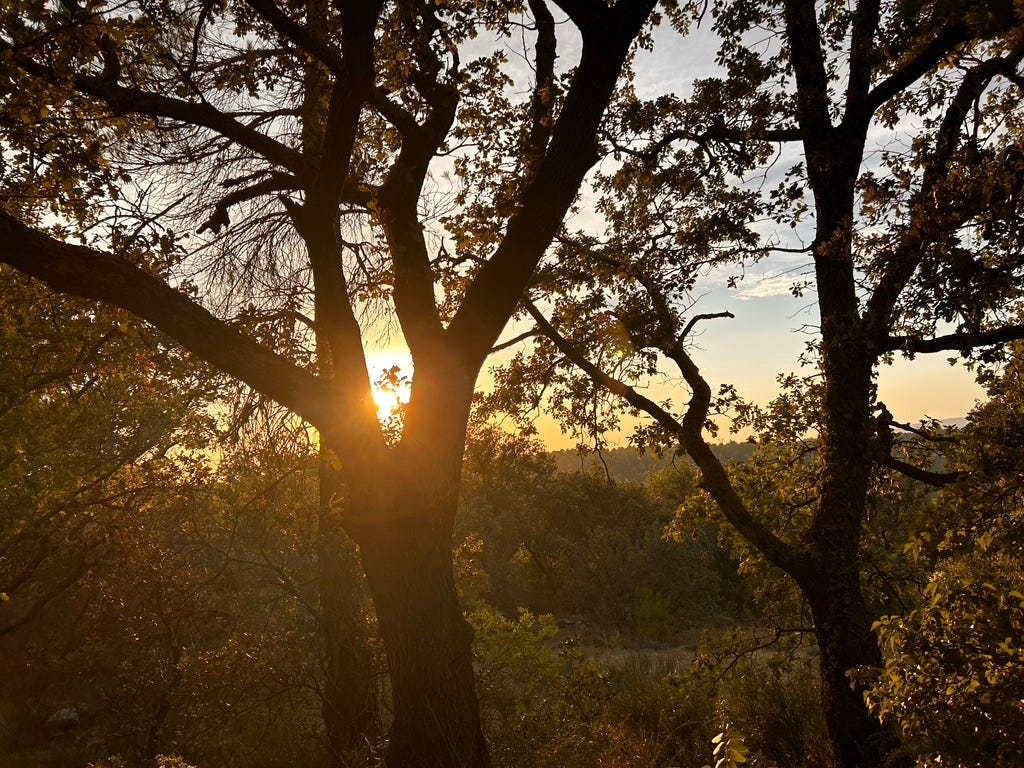
Psychologically, when we immerse ourselves for a whole day or two near a river with its own agenda, a lake outside time, trees that have taken up space for decades, we are gently stunned into a state of awe. Awe is this feeling that arises when we encounter something so vast that it exceeds our ordinary mental frameworks and asks us to accommodate a larger reality. Nature is one of the most consistent sources of awe. Mountains, forests, oceans, and star-filled skies reliably evoke this feeling, which has been linked to greater generosity, curiosity, humility, and a diminished preoccupation with the self. Immersion in nature has been empirically linked to feeling less lonely; nature shifts our focus from our individual needs to collective concerns that bind us to each other. In short, spending time in places that remind us we are not the centre of the universe is good for all of us, together.
(Ok… this is my regularly-scheduled plea to click on the links I provide! I work hard to curate scientifically sound studies that will give you a flavour for how deep the science goes into these claims. I try hard to make the links open-sourced. Like this one, showing that an “awesome” eclipse plays a vital social function by arousing awe and moving individuals towards caring about the collectives they belong to).
Being… in the right hemisphere
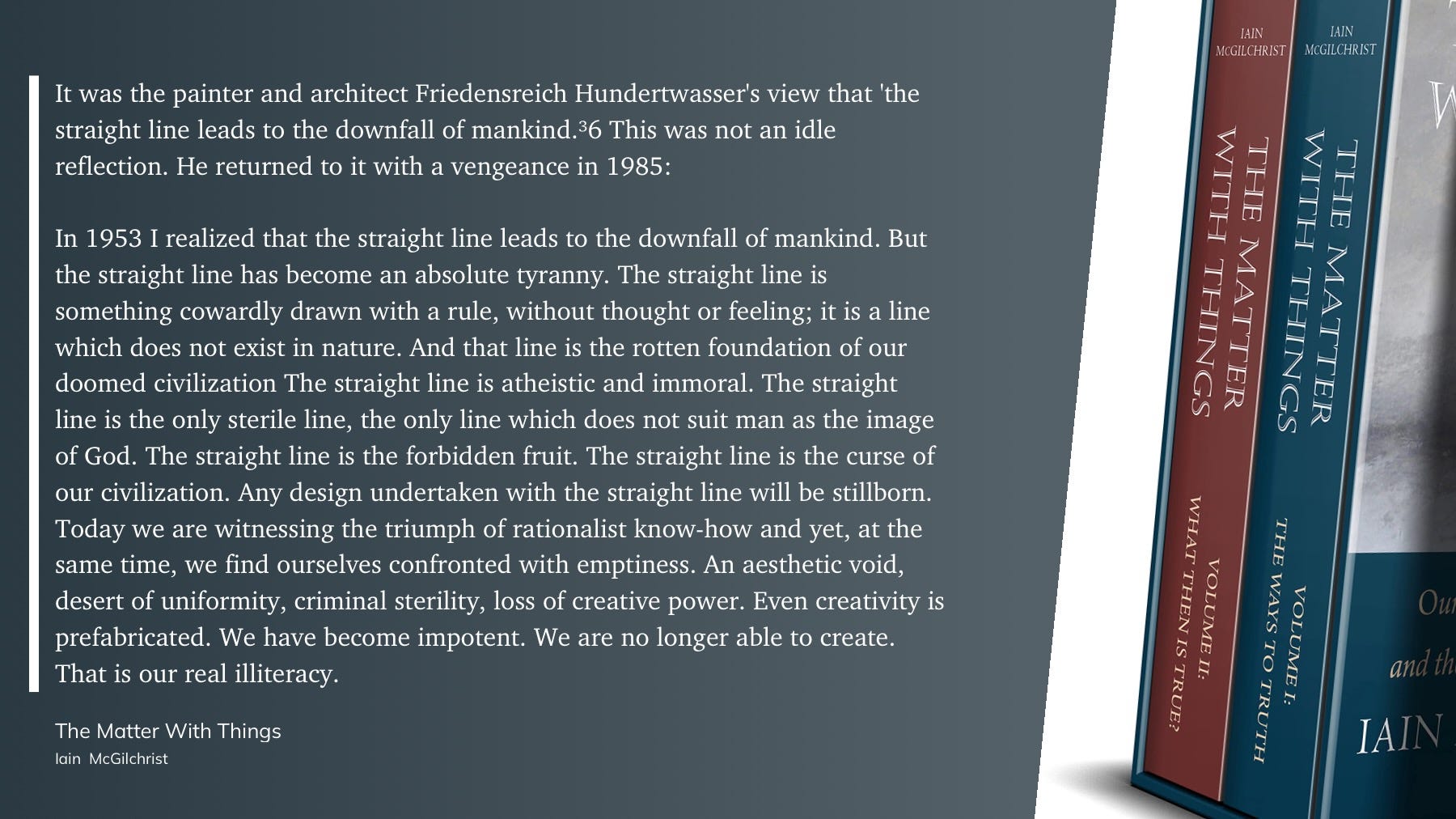
Let’s pull in one of my intellectual heroes, Iain McGilchrist, and his phenomenal interdisciplinary work, The Matter with Things (2021). I’ve interviewed dr. McGilchrist and read 2000+ pages of his work, so I feel well-versed in his model and have applied it extensively in our work at Liminal Learning and beyond. His core argument is that there are two distinct, brain-based modes of engaging with “reality.” The right hemisphere approaches the world holistically, attending to flow, gist, and context. The left hemisphere isolates, analyzes, categorizes, and manipulates. His claim is that in healthy individuals and societies, the movement begins in the right hemisphere’s direct encounter with the world (what McGilchrist calls “presencing”), then into left-hemisphere analysis, then back to the right hemisphere where those direct observations are either integrated into a new conceptual understanding or rejected and reconfigured. When the loop closes inside the left hemisphere and stops returning to the right, what gets lost is the potential for the encounter with reality to be deeply felt, without categorization.

What immersing in wilderness does, mechanistically, is shove the right hemisphere softly back into the lead. The environment is too large, too indifferent, and too sensorially complex to be captured in a concept or boxed neatly into a category. When we’re in nature, we need to constantly and sensitively respond to its shifting sensorial moods. We put the sweater on as the sun fades, we turn our lamp on as the sky fades to mauve, we clamp down the corners when the wind whips our tent, and we FEEL all this before the left hemisphere can label, classify, or analyze any of it into something good/bad/easy/hard.
Nature is so very particular, sending soft bids for attention with every unique shape of leaf, blade of weed, wisp of petal, flap of wing, and whiff of blossom. Our attention is stirred, not “notified”. We are always in constant invitation to participate. Nature provides no clean borders, abstractions, analytics, or generalizations in its right-hemisphere vibe.
One of the things we hear over and over from young people that come out on our Liminal Learning Quests is how surprising it feels to experience their attention so differently in nature. Right-hemisphere flow changes the quality of their attention such that it feels easy and quiet on the one hand, and also tuned in, responsive, and alive, on the other. They’re attuned without being reactive. They respond,spontaneously and without practice. They are present, but without vigilance.
Now compare this right-hemisphere immersion in nature to the ubiquitous social media scrollfest that consumes many of us today. The standard critique of social media focuses on dopamine loops, compulsive scrolling, and the comparative misery of measuring your ordinary life against everyone else’s curated highlights. There is an additional, prior problem: when we are on our phones, we are almost continuously in left-hemisphere mode. The images, stories, and essays we consume represent experience but they never deliver it directly. The newsfeed is not delivering information about the world. The newsfeed IS our world. It is creating the world we live in, not just describing something “out there” that we get back to after we watch a few more war reports. Our digital tools are now hijacking our left hemisphere and actively discouraging the shift to embodied knowing. The extraordinary digital architectures that we’ve erected were built by our collective left hemisphere activity and now those digital worlds, in turn, constrain the types of creative possibilities at our disposal. Most of us spend the majority of our waking hours inside this architecture, with our bodies and feelings outside, flailing for attention and care.
The costs of left-brain dominance
One of the biggest costs of being stuck in our left-hemisphere processing is that we lose touch with what inspires us. We often misunderstand the goal of finding our life’s meaning and purpose as one of logical, rational decision-making. It is mostly not, not at first. It’s hard to identify what your purpose is, what you derive meaning from, if you can’t feel what moves you. When we get stuck in narratives, abstractions, and inside the digital world that house them, the distance from our emotional impulses, desires, aspirations, and embodied wisdom grows. Dropping into experience is dropping into your own internal states. Those internal states are what your body is actually registering in the non-linguistic, sensory way that precedes any story about how you feel and who you are.
There is this heart-wrenching confusion that many young people feel when I ask them about what inspires them, what captures their interest, what they notice stirring them into action. They are not used to paying attention to those internal lightbulb moments. Hell, they’re not used to paying attention to any internal signals; it’s all a big mash-up of ick or yum, and further distinctions haven’t been practiced. So they either never learn to attend, or they lose it after childhood because they’ve been inundated with educational practices that pull them repeatedly out of direct experience and into analysis, synthesis, reporting, and performing what they know. But the good news is that there are learnable practices, embodied social exercises, that help us attend to what stirs us experientially, and teach us to link those stirrings to a world that is calling us to show up with agency and heart.
Finding meaning and collective purpose are not problems that more introspection will solve. They don’t need to learn more problem-solving strategies. The accumulated self-concept, built up over years of matching our behaviours to expectations and coming up with stories so we will be accepted by others, is itself a left-hemisphere product. To get back in touch with what authentically moves, inspires, and motivates us, we need lived (often challenging and emotionally difficult) experiences at the edge of our logical knowing.
“Without your wound where would your power be? It is your very remorse that makes your low voice tremble into the hearts of men. The very angels themselves cannot persuade the wretched and blundering children on earth as can one human being broken on the wheels of living. In Love’s service only the wounded soldiers can serve.”
Excerpt from Thornton Wilder’s play, in The Angel That Troubled the Waters:
Another major cost of living under the hostile takeover of the left-hemisphere is our compromised capacity for empathy. Done right, empathy is not a cognitive operation. McGilchrist argues in The Matter with Things that the right kind of knowing requires “neither abstract cognition on its own, nor the promptings of feelings alone, but their fusion in an intelligent understanding of the situation as a whole.” Real empathy is that fusion. You can only deeply feel another person’s grief if you have sat in your own and there is a nonlinear quality to how that sitting expands you: each time you are back on your knees, stricken by experiences of sorrow of some sort, your aperture for receiving another person’s reality widens, sometimes permanently. Robert Kegan, in The Evolving Self (1982), put it this way: “…seeing better increases our vulnerability to being recruited to the welfare of another. It is our recruitability, as much as our knowledge of what to do once drawn, that makes us of value in our caring for another’s development.” Recruitability requires porousness, and porousness requires practice in our own felt experience.
“Before you know kindness as the deepest thing inside, you must know sorrow as the other deepest thing.”
Naomi Shihab Nye, from Kindness
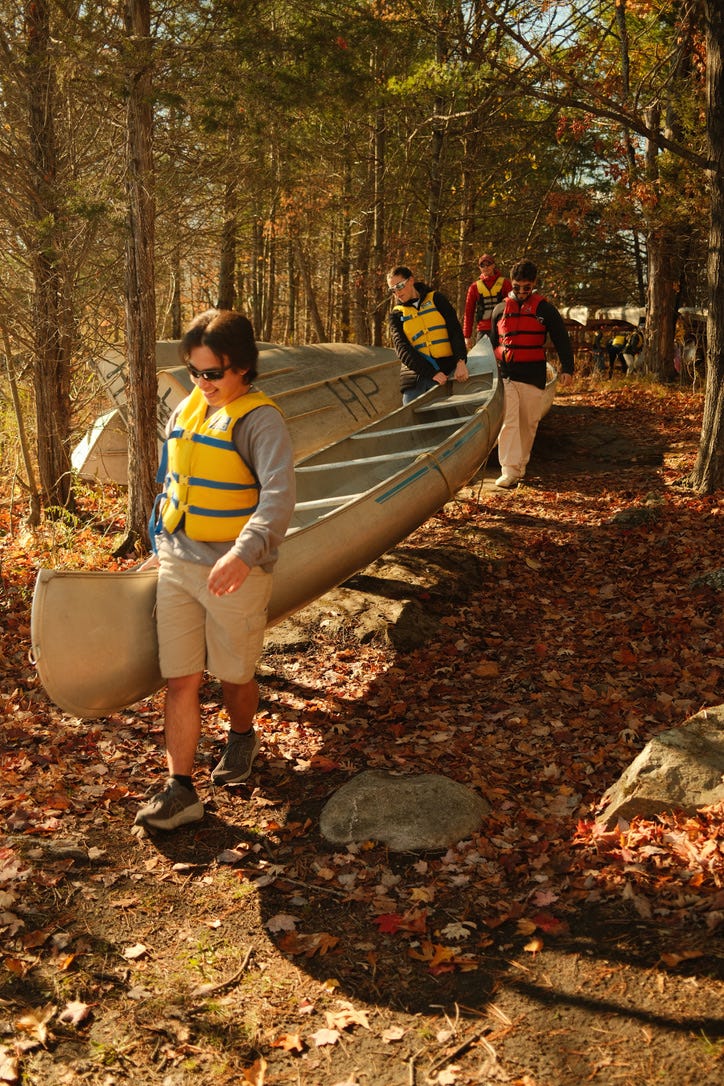
Going back to the points about nature, what makes shared time in wilderness specifically so life-changing is not only that each person drops into their own experience, but that they do it together, under the same conditions, in the same body-scale environment. The cold hits all bodies equally; the portage breaks everyone at the same point; the silence at dawn is the same silence for every person lying in it. When bodies share physical conditions, what you sense in yourself resonates with higher probability with what the person beside you is sensing. That unmediated, unpracticed, unpredictable, resonance is felt rather than inferred and is the fertile ground on which empathy is built.
The argument points past these collective stakes toward something more basic: a different mode of inhabiting your own life. The practice of presencing — allowing the right hemisphere to do its work before the left hemisphere names and manages what it finds — is not confined to forest trails. Zhuangzi calls the person who has learned to live this way a virtuoso: someone who “dwells without thinking, moves without calculating, harbors no ideas of right and wrong or beautiful and ugly.” I don’t think of this mindset as passivity as much as changing our relationship to the world we encounter and seeing the body and the environment as interconnected, always weaving, data sources towards which we can learn to attune to daily, not problem-solve away.
Wilderness is one of the few remaining environments that enforces this mode and provides conditions for shared presencing at the same time. In the nature that still feels so foreign to me oftentimes, I’m learning to stay in experience long enough to be changed by it, and to read another’s experience as something felt rather than inferred. It’s the work I’d like to be doing more and more of with my own adult children and it’s exactly what we immerse ourselves in during the first week of Liminal Learning.
If you’ve come this far, let’s go just a bit deeper and weave our right hemispheres in empathic rhythm, shall we? Poetry, to me, is one of the most efficient and magical conduits through which we can share experience and find genuine attunement across distance and time. This poem by the awe-some Naomi Shihab Nye expresses in a few lines what has taken me SO VERY MANY pages. xo
Kindness
1952 –
Before you know what kindness really is
you must lose things,
feel the future dissolve in a moment
like salt in a weakened broth.
What you held in your hand,
what you counted and carefully saved,
all this must go so you know
how desolate the landscape can be
between the regions of kindness.
How you ride and ride
thinking the bus will never stop,
the passengers eating maize and chicken
will stare out the window forever.
Before you learn the tender gravity of kindness
you must travel where the Indian in a white poncho
lies dead by the side of the road.
You must see how this could be you,
how he too was someone
who journeyed through the night with plans
and the simple breath that kept him alive.
Before you know kindness as the deepest thing inside,
you must know sorrow as the other deepest thing.
You must wake up with sorrow.
You must speak to it till your voice
catches the thread of all sorrows
and you see the size of the cloth.
Then it is only kindness that makes sense anymore,
only kindness that ties your shoes
and sends you out into the day to mail letters and purchase bread,
only kindness that raises its head
from the crowd of the world to say
It is I you have been looking for,
and then goes with you everywhere
like a shadow or a friend.
I have spent considerable time thinking about John Gottman’s work on relationships and specifically how we “bid” for attention. Your comments on how nature subtly bids for our attention and how it’s up to us to choose to engage are thought provoking.